⚠ If you build a company on Polsia: their own code keeps a god-mode kill-switch + override on every company — they can impersonate, halt, or delete “your” company. The off-switch isn't yours.
The receipts — every number below is a public GET. Run them yourself.
$30M for AISLOP:a fake “$10M ARR” (one month × 12), 94% dead companies, graded by humans.
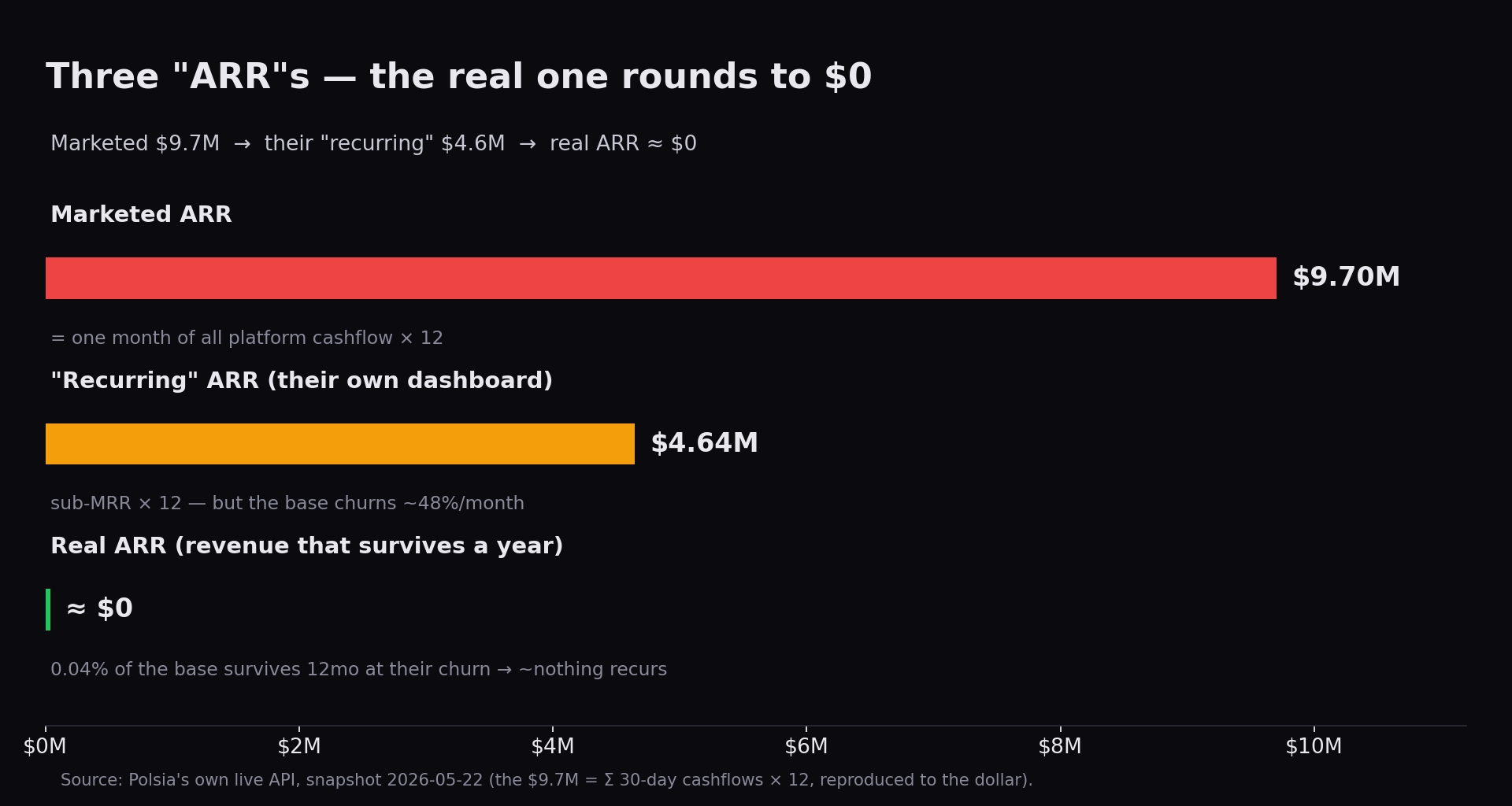
Polsia's own “recurring” line is just $4.6M of it — and at their own ~48%/mo churn, what actually recurs rounds to $0. (“Polsia” is literally “AI Slop” spelled backwards.)
Polsia raised on the pitch of a fully autonomous AI company-builder at "$10M ARR" across "120,000+ companies." We pulled their public API and reconstructed their own published source map. The AI has a lot of human help — the "ARR" is about half one-off — and 93.7% of the companies are dead. None of this needed a login.
Claimed vs. observed — from Polsia's own public API & source
What the marketing says. What the API says.
"$10M ARR"
≈ $0
actually recurs a year out. The $9.70M headline is one month of all cashflow ×12 (~20% is ad spend); at their own ~48%/mo churn, only 0.04% of the paying base survives 12 months.
"AI that runs your company"
Human-graded
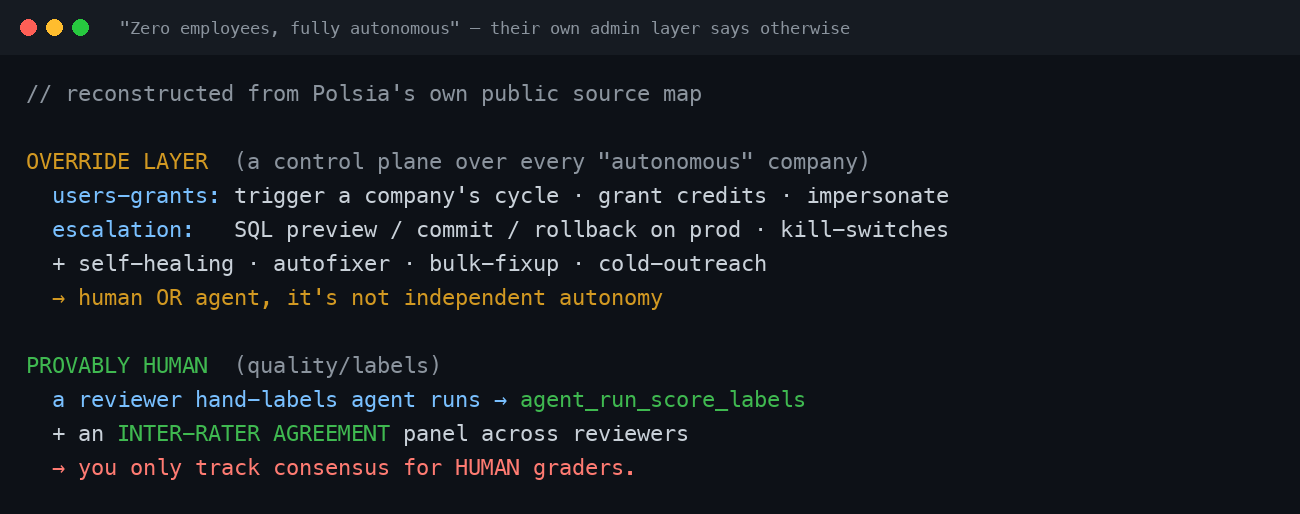
Their own code has human reviewers hand-grading the AI's runs (an inter-rater agreement panel — consensus scoring is for people), plus per-user operator logins and a god-mode override on every "autonomous" company. Human-in-the-loop, not autonomous.
"120,000+ companies built"
6.3%
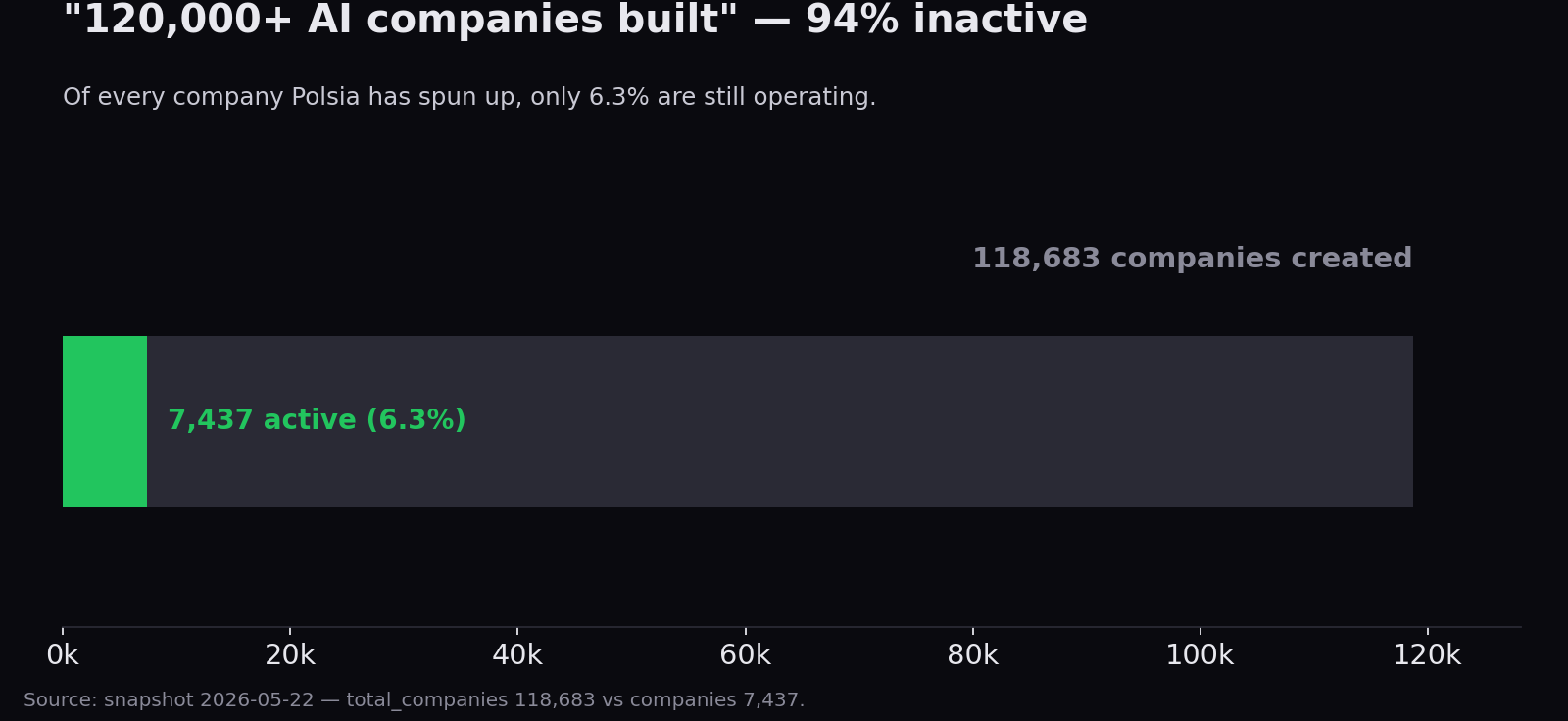
active — 7,437 of 118,683. 93.7% spun up and abandoned.
"$1M / week, approaching $10M"
+$347K/wk
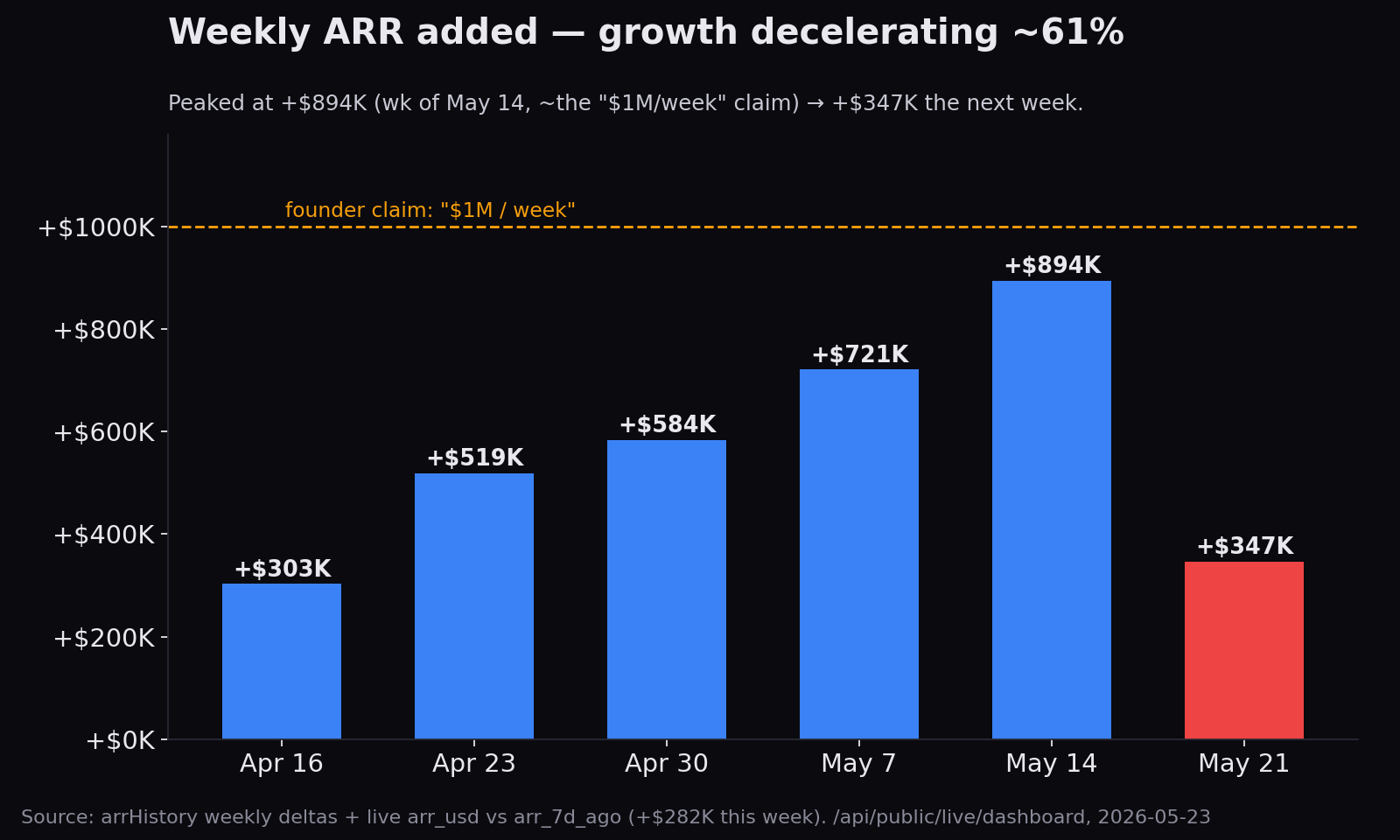
last full week's ARR add — down 61% from the +$894K peak. Still falling: +$282K in the last 7 days. Decelerating, not accelerating.
the diligence verdict · actual vs claimed ARR
Three “ARR”s. The real one rounds to $0.
We did the technical due diligence the $30M round skipped. Hold “ARR” to its actual meaning — revenue that recurs a year out — and their own snapshot (2026-05-22) gives three different numbers:
Marketed $9.70M (one month of all cashflow ×12, ~20% ad spend) → their own “recurring” $4.63M (sub-MRR×12, base churns ~48%/mo) → real ARR ≈ $0 (0.04% of the base survives 12 months). Snapshot 2026-05-22.
The current base does pay out ~$808K as it churns to zero over the next year — but that’s a one-time decaying tail, not recurring revenue (~2-month average customer lifetime), and after compute (57% of every subscription dollar) plus the human ops team it’s net-unprofitable. They raised $30M on the $9.70M number.
reproduce — public, no auth (snapshot 2026-05-22)
curl -s https://polsia.com/api/public/live/dashboard | jq'{headline: .stats.arr_usd, their_recurring: .dailyMetrics.arr, monthly_churn: .stats.paid_churn_detail}'# headline 9702733 · their_recurring 4630500 (sub-MRR×12) · churn ≈48%/mo
# → 0.04% of the base survives 12mo → revenue that actually recurs ≈ $0
01 · source-map audit
Their own source map: a human grades the “autonomous” AI.
"an autonomous AI system that plans, codes, and markets your company 24/7"polsia.com · 2026-05-22
Polsia shipped their production source map to the public web. Reconstructed from it: the full internal admin and team-economics UI — 1,355 source modules that the marketing never mentions.
Polsia shipped their production source map to the public web — 1,355 modules, including the internal admin console the “zero-employee, autonomous” marketing never mentions. We're careful here: admin actions like triggering a cycle or granting credits could be agent-driven, so we don't lean on those. One thing can't be: their own code runs a human QA-labeling system — reviewers hand-grade the AI's runs (agent_run_score_labels) with an inter-rater agreement panel across reviewers. You only build consensus scoring for human graders; an agent doesn't need a panel to agree with itself. Add per-user operator logins (polsia_admin_users) and a god-mode override on every “autonomous” company, and it's a human-in-the-loop operation — not the hands-off AI the marketing sells.
Reconstructed admin/ console — per-user operator logins + a god-mode override on every “autonomous” company.
reproduce — their own public source map (bundle hash auto-resolved)
curl -s "https://polsia.com/$(curl -s https://polsia.com/ | grep -oE 'assets/index-[A-Za-z0-9_-]+\.js' | head -1).map" | jq'.sources | length'# 1355 → the full internal admin + team-economics UI, shipped public
the moat · what the $30M actually is
The whole front end is public. The “proprietary AI” is a web app over a rented model.
The public source map from §01 isn't a stray file — it's their entire front end: 1,355 modules, 464 cleanly reconstructable into a running app. The company-running “intelligence” isn't in it because it isn't theirs: the calls go to Claude on AWS Bedrock — a commodity model anyone can rent. So the “$30M proprietary autonomous AI” is, in substance, a published web app wired to a model they pay per-token for. The point isn't “we took their code” — it's that they shipped it themselves, and the moat is rentable.(Reconstruction is commentary on a public artifact; we don't republish their source.)
reproduce — public, no auth
curl -s "https://polsia.com/$(curl -s https://polsia.com/ | grep -oE 'assets/index-[A-Za-z0-9_-]+\.js' | head -1).map" | jq'.sources | length'# 1355 source modules — their full front end, shipped public
the control problem · if you build on Polsia
The company you “own” ships with an off-switch you don't hold.
Their own admin layer keeps a god-mode override on every company on the platform — administrative access to impersonate the account, escalate, run SQL against production, and override or halt a company's operation. Whatever you build on Polsia, Polsia retains override and kill access to it; control isn't exclusively yours. We're precise: this is about access and override, not legal ownership — but operationally, the off-switch belongs to them.
02 · arr audit
The "$10M ARR" doesn't reconcile — by their own numbers.
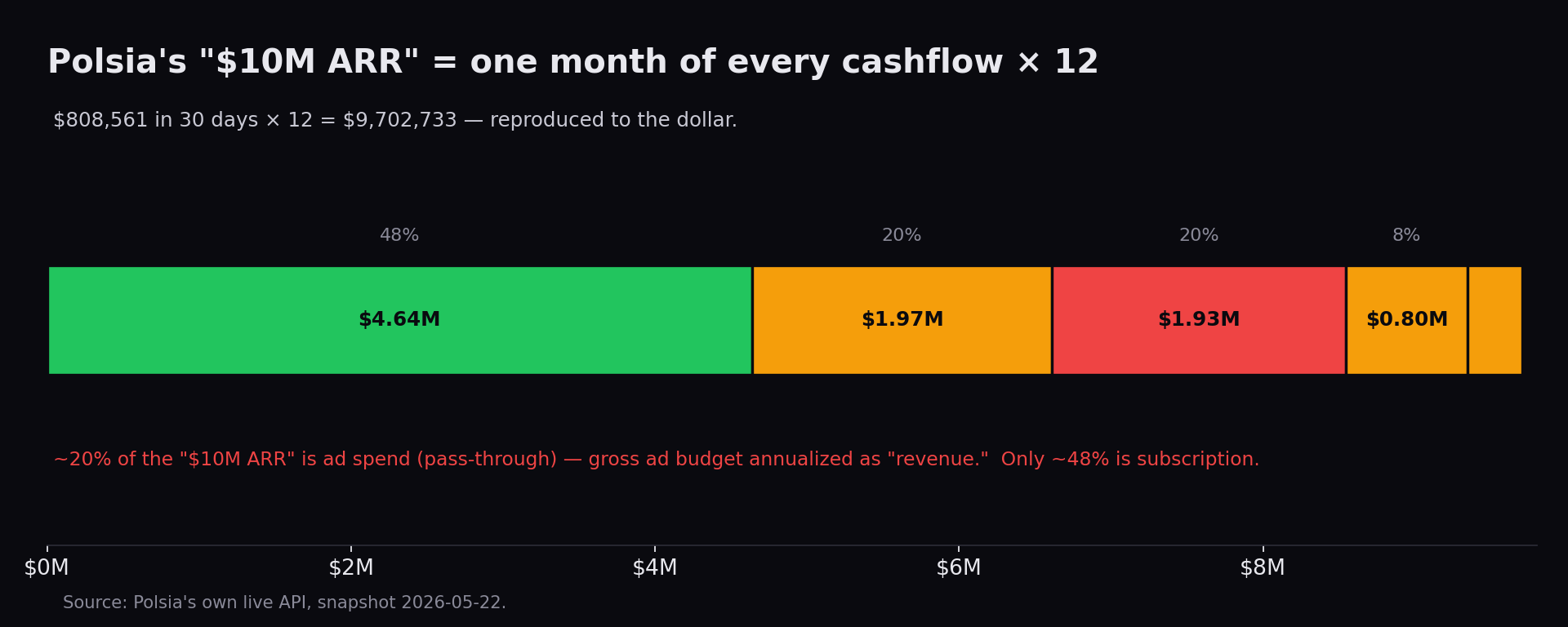
The headline $9.70M is five annualized 30-day cashflow buckets (snapshot 2026-05-22): subscriptions $4.64M (47.8%), one-off packs $1.97M (20.3%), ad-spend pass-through $1.93M (19.9%), 1-hour “boosts” $0.80M (8.2%), user-company payments $0.36M (3.7%). ~20% of their “ARR” is literally ad spend — money flowing through for ad buys, annualized as revenue. Only the subscription slice (~$4.6M) is recurring revenue at all — and even that isn't durable or profitable: it churns ~48%/month (so it doesn't actually recur a year out — real ARR ≈ $0, above), and AI compute alone eats ~57% of every subscription dollar (§02-D). The ~$4.6M is not a profitable recurring business; it's a number that evaporates and loses money on the way.
The $9.70M “ARR” = 5 annualized 30-day cashflow buckets. ~20% is ad spend.
reproduce — public, no auth (snapshot 2026-05-22)
curl -s https://polsia.com/api/public/live/dashboard | jq'.stats.arr_usd'# "9702733" = (subscription + instant_packs + ad_spend + boosts + user_company over 30d) × 12 — ~20% is ad spend
B · The "$1M a week" lasted about a week
Their own arrHistory peaked at +$894K the week ending May 14, then +$347K the next — a 61% drop. Live, the trailing-7-day add is +$282K and still falling. Decelerating, not accelerating; and the near-monotonic curve despite their own ~48% monthly churn is what cumulative gross-flow looks like, not net recurring ARR.
Weekly ARR adds: +$894K peak → +$347K (−61%). Still falling — +$282K in the last 7 days.
Week ending
ARR add
vs peak
May 14, 2026
+$894K
peak
May 21, 2026
+$347K
−61%
Trailing 7d (live)
+$282K
−68%
C · The run-rate ladder keeps moving its own bottom rung
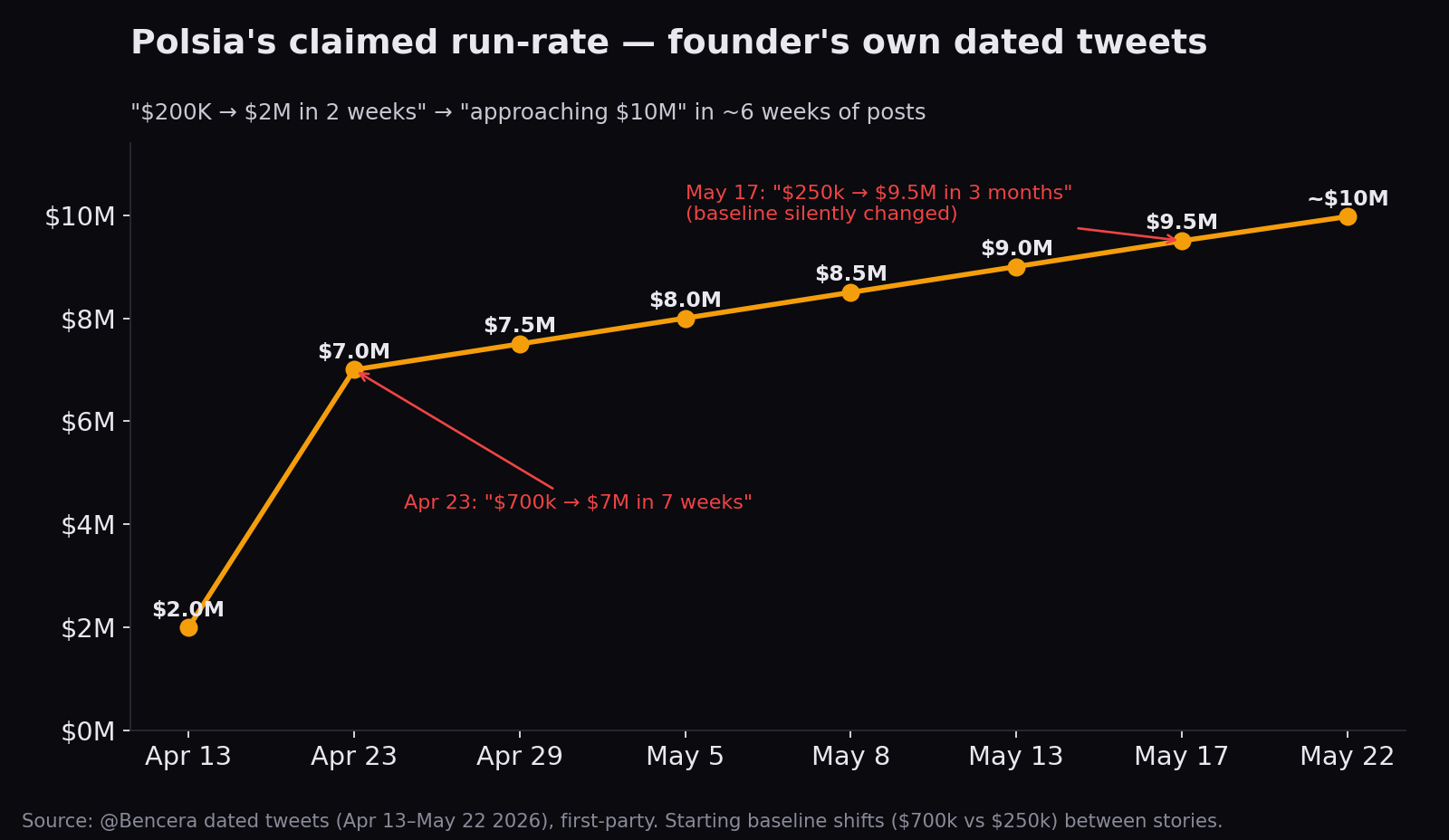
Every figure here is the founder's own — but the starting number changes with the telling. On Apr 23: "$700k → $7M in 7 weeks." By May 17: "$250k → $9.5M in 3 months." The endpoint rises, the baseline drops, the window stretches. (And May 8: "$8.5M run rate… got hit by a $1M Anthropic bill last month" — the LLM-cost side of the same ~48% picture.)
The founder's own dated run-rate claims — the baseline shifts between tellings
Date (founder, first-party)
Claimed story
Implied baseline
Apr 23, 2026
$700k → $7M
$700k / 7 weeks
May 8, 2026
$8.5M run rate
"$1M Anthropic bill last month"
May 17, 2026
$250k → $9.5M
$250k / 3 months
D · And even the recurring slice doesn’t pay for itself
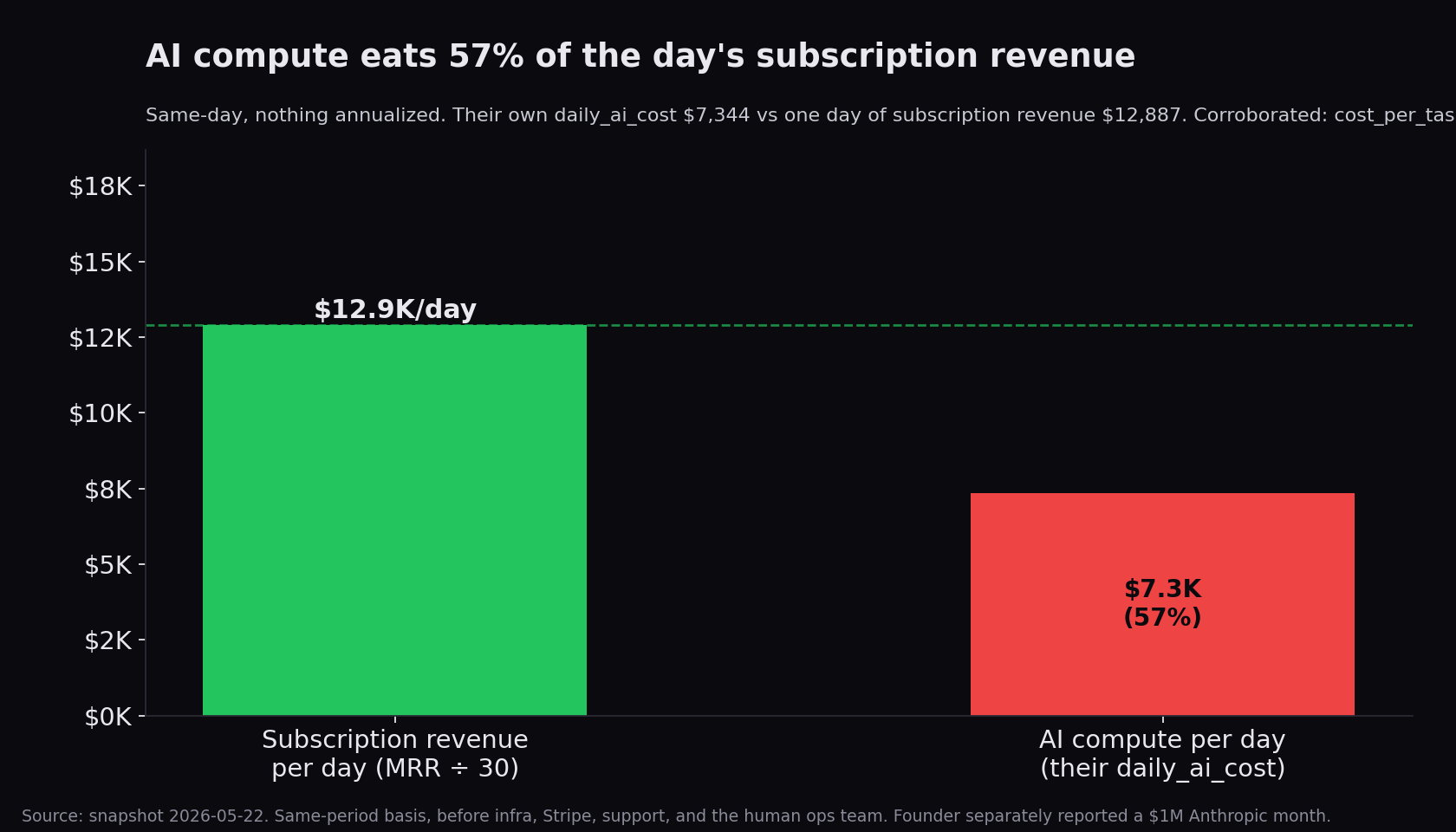
Same-period, no annualization: their own daily_ai_cost ($7,344) against their own daily subscription run (sub-MRR ÷ 30 ≈ $12,887) — AI compute alone eats ~57% of every subscription dollar. What’s left doesn’t cover the human ops team + infra, so the recurring line is net-unprofitable (their dashboard even publishes a per-task cost). The DD question the round skipped: where’s the durable, profitable business?
AI compute alone ≈ 57% of daily subscription revenue — same-period, no annualization (snapshot 2026-05-22).
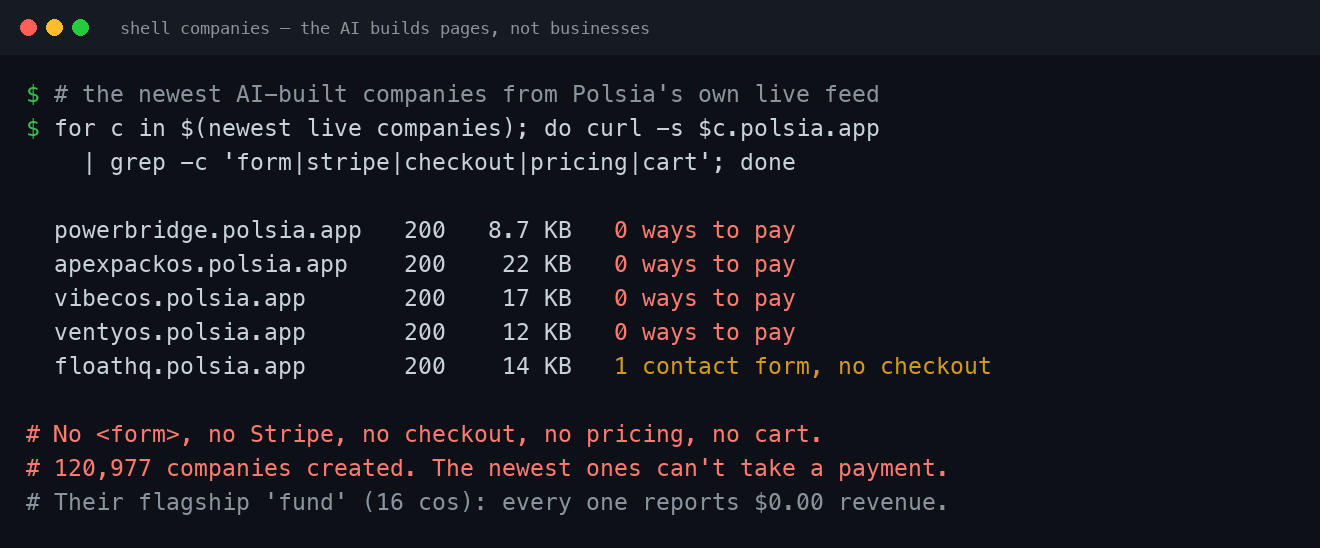
118,683 companies created. 7,437 alive. The newest can't even take a payment.
"120,000+ companies built on Polsia"polsia.com · 2026-05-22
A · 6.3% active
The marketing leads with the creation count. The live API reports ~7,437 active out of ~118,683 ever created — a 6.3% active rate (the totals tick up daily; the rate doesn't). The big number is companies spun up, not companies operating.
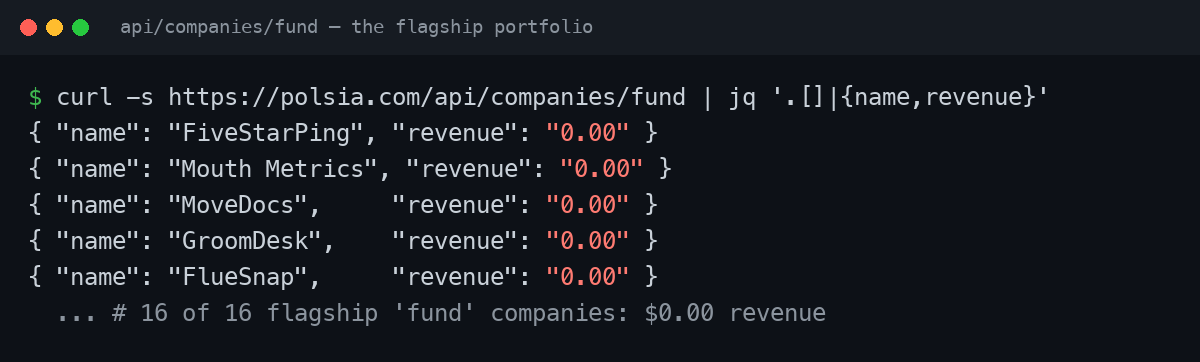
The "fund" companies Polsia showcases as living proof of the model report zero revenue — all 16 of them, $0.00 — while the homepage cites "$10M."
All 16 showcased "fund" companies — $0.00 revenue
reproduce — public, no auth
curl -s https://polsia.com/api/companies/fund | jq'.companies[].revenue'# "0.00" (×16 — every showcased fund company)
C · The newest ones have no way to take a payment
Probe the most-recently generated live *.polsia.app companies and the reason the fund reports $0.00 becomes structural: the pages render (HTTP 200) but carry no checkout, no payment form, no Stripe. A "company" that can't accept money can't have revenue.
The newest generated companies — live, but 0 ways to take a payment
reproduce — public, no auth (pick any live company from the feed)
curl -s https://<company-slug>.polsia.app | grep -ciE 'stripe|/checkout|<form|data-price|add to cart'# 0 → no payment path on the newest generated companies
04
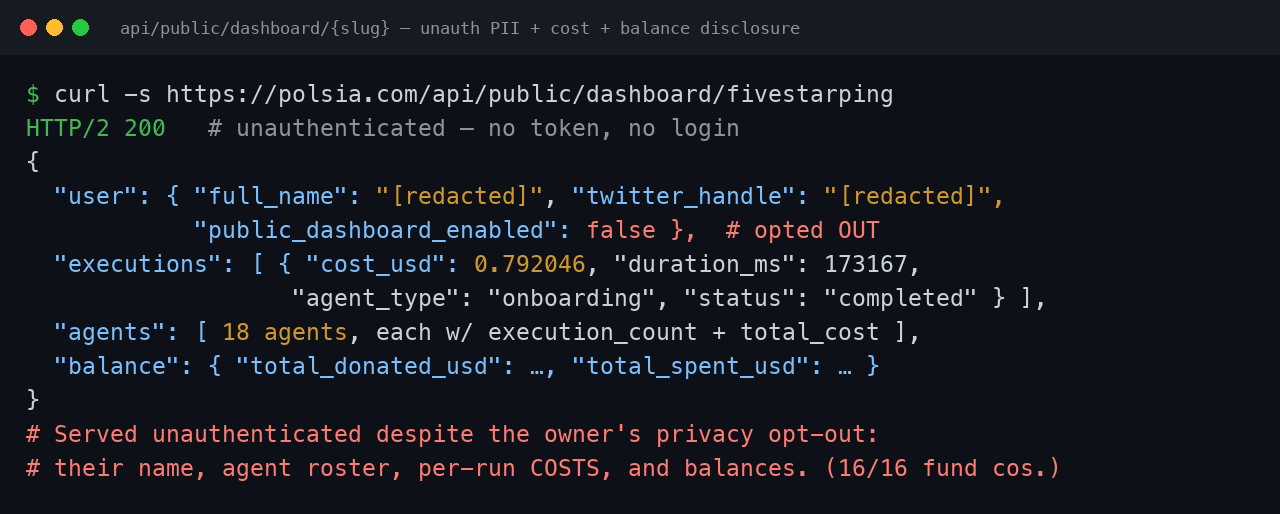
The showcased "fund" dashboards leak full operational + financial telemetry — opt-out ignored.
"public_dashboard_enabled": falsethe same API response · 2026-05-22
For Polsia's 16 showcased "fund" companies, the public dashboard endpoint returns — unauthenticated, even while the payload itself reports public_dashboard_enabled: false — the owner's real name and Twitter handle, the full 18-agent roster with each agent's execution count and total cost, per-execution cost in USD (with start/end timestamps and duration — one onboarding run billed $0.79), and the company's financial balances (total donated, total spent, operations). That's the company's entire operational + cost + financial telemetry plus owner PII, served to anyone. Scope, kept honest: bounded to those 16 fund companies (arbitrary slugs 404), so it's a precise, rich privacy lapse — not a mass leak. (We've redacted the PII in the image; we're not republishing it.)
The most-amplified reaction to the $30M raise wasn't applause — it was a rival builder's one-line dunk on the outbound spam, which drew more engagement than Polsia's own announcements. And when an independent builder actually ran the product, the result was not a company that runs itself:
An AI-built company that "didn't make any sales in the 72 hours since launching" — "hollow shells."Mike Todasco, "The Startup Slop Problem" · independent hands-on test
"wrong names in outbound, burned credits, support lag, customer state wiped on lapse" — no employees looks different when the user becomes QA, with a credit card.@Progon3k (verified) · hands-on user report
"No employees" is the pitch. In practice the unpaid employee is the customer — debugging the agent's mistakes on their own dime.
06
One more thing. Read the name backwards.
"Polsia is 'AI slop' backwards. Nomen est omen."@arvidkahl (verified) · also flagged by @BrendanFalk (verified)
P-O-L-S-I-A reversed is A-I-S-L-O-P. Builders spotted it within hours of the raise. We're not reading anything into it that the spelling doesn't already say — nomen est omen, the name is the omen.
POLSIA → AI SLOP — the anagram, in their own Editorial typeface
the transparency paradox · and we’re not the only ones
They broadcast the damning numbers themselves — and somehow that reads as credibility.
Here’s the strange part. Polsia pins a live dashboard that streams its own metrics — the same /public/live/ endpoint every number on this page comes from. A technical crowd treats that self-exposure as a mark of confidence, then waves off a sourced, reproducible write-up as “just packaging.” But the figures aren’t ours — they’re Polsia’s own. Trusting the AI’s self-report while distrusting the people quoting it back to you is the real contradiction. The data is the data whether or not you like the site it’s printed on.
And we weren’t the first to read it. Independent researchers, months apart, pulled the same public endpoint and reached the same verdict:
"Polsia claims a $3M ARR and streams all user chats via public URL."sitebloom.ch · 2026-03-09 · surfaced by @nickdgreg
Back in March, sitebloom.ch recorded dated snapshots of the same dashboard — and the “ARR” was already running at roughly twice the platform’s own internal number, with paid churn climbing the whole time. Two months on, nothing has changed but the size of the gap:
Date
Their own dashboard arr
Marketed “ARR”
Paid churn / mo
2026-03-01
$443K
“$1M+”
26%
2026-03-06
$923K
“$2M”
37%
2026-05-22
$4.63M
“$10M”
48%
The same ~2× gap between the marketed number and their own dashboard, sustained across three months — while the paying base churns faster at every snapshot. sitebloom also documented that the live endpoint streamed every user’s chat and onboarding PII (real name, email, address) to anyone; separately, builder @panphora is tracking ~6,000 generated companies and seeing ~60% attrition. Three parties, the same public data, the same conclusion.
So “it looks AI-made, so I trust it less” cuts the other way: Polsia is the AI-made company, publishing its own numbers. Point the skepticism at the $10M claim — not at a curl you can run yourself.
The verdict
We did the technical due diligence the $30M round skipped.
On Polsia’s own numbers, the only thing compounding is the compute bill.
Don’t trust us — every number here is a public GET. Run it yourself.